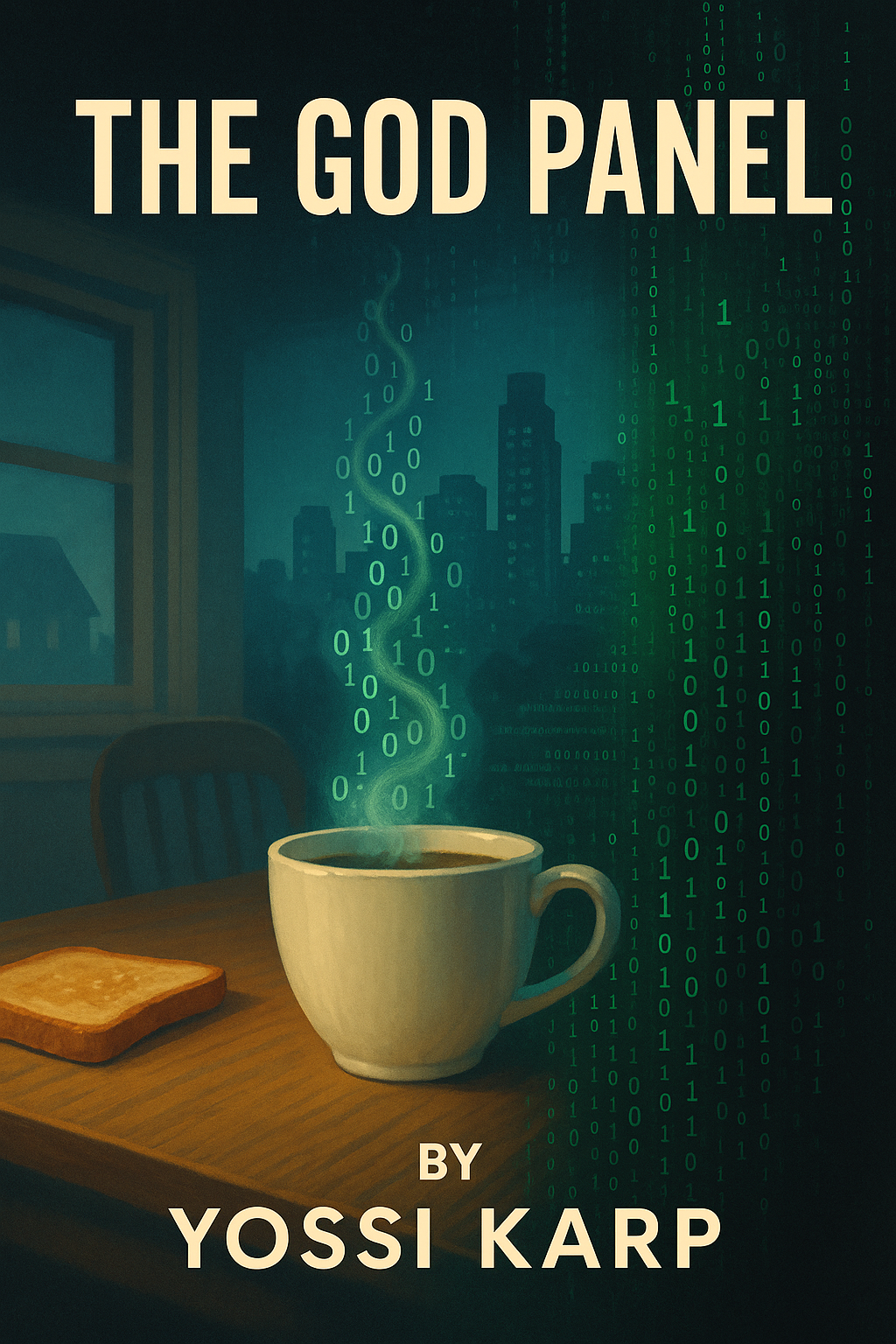
The God Panel
“I don’t get it.” The Professor’s wife looked over the rim of her coffee cup, contemplating her husband’s last statement. “All this isn’t real? So I don’t feel or, or… what? Exist? I’m just ones and zeroes?”
Avery put down his toast and crinkled his brow. “This thought experiment poses that it’s possible we’re all living in a computer simulation. If posthuman civilizations decide to run simulations of their ancestors, the statistical implication is that we’re one of those simulations.”
“So, statistically, I’m not a real person? I can do whatever I want? Life doesn’t really matter because we’re all just bits and bytes, electrical impulses in some advanced microchip?”
“Hmmm… so if we’re a simulation, you think that nothing should matter?” asked the Professor.
“Not sure. Just thinking aloud.”
“Well, let’s say for a minute that we actually are a simulation. Do you stop feeling hunger? Pain? Does eating pretzels still make you thirsty? All those things will still be true, which means your feelings will still be real to you, objectively.”
“Objectively to me, a person who doesn’t actually exist.”
“Not exactly. Ethics and morality are still important because our experiences and feelings are meaningful to us. So, if you go outside now and hit someone over the head, they’re still going to feel real pain, and you’re still going to jail. Knowing that you’re in a simulation actually changes nothing.”
“If nothing changes, it means I still have to go to work, even though my boss is just a simulated character in an elaborate computer game?”
“Afraid so,” the Professor smiled.
“Well, then, I’d better get to it. It’s a big day today. Major release. Anyway, enjoy your day, Avery, even if it’s not a real one.”
The Professor watched through the window as Susan’s car pulled out of the driveway. As he washed his wife’s coffee cup, he replayed the conversation in his mind. If we are a simulation, he thought, it means we’re inside computer code, or we are computer code. And what’s the one thing about any kind of computer code? There’s always a vulnerability. Even posthuman civilizations with their advanced technology can’t possibly write airtight code, can they? And if that’s true, there has to be a way to exploit that code, if we can find it.
The Professor stared out the window he turned the coffee cup over and over in his hand. Finally, it slipped from his grasp, back into the dishwater. But how would one even go about finding such a vulnerability? Even if you found the codebase for the simulation, how would you interact with it from inside the simulation itself? And what would you do with it?
The Professor spent the rest of the day grading papers, but his mind was never far from the morning’s puzzle.
Susan came home shortly after five in the afternoon and startled him in his office. “What are you working on?”
“Oh, hi. You’re home. Um, yeah. I got through all the grading. Torture.”
“Any standouts?”
“One or two really good ones. More pretty bad ones. There’s this one student who insists on indenting his code with spaces.”
“Exasperating. What’s for dinner? Smells good.”
“Meatloaf is in the oven. Should be just about ready.”
They ate in silence. Then suddenly, Avery asked, “So if we are living in a simulation and we’re all just code, how would you go about finding holes in it?”
“Are you still on that, Avery?”
“Well, it stands to reason that any code, no matter how advanced, still has some sort of weakness that we could find to, you know, prove the theory.”
“Why would you want to do that? Didn’t you say this morning that knowing that you’re in a simulation changes nothing?”
“If you simply know about it but can’t do anything with that knowledge, sure. But if you somehow can access the code and manipulate it…”
“All right, then. Let’s say it’s true. Say we’re all just pre-programmed bots and you can do something about it, what would you do?”
“Everything! Anything! We could reprogram sick people to become healthy, or even change the laws of physics!”
“Change physics?”
“Yeah, you know, give people the ability to fly, or whatever.”
“You want to disrupt the existence of the entire human civilization so you can fly?”
“For example, but not only.”
“Right, so you’ll heal all the sick people and bring peace on Earth.”
“Maybe.”
“Messiah complex, much?”
“But isn’t that what we always strive for? Isn’t that why we’re here, to help others?”
“Is that what you think will happen? That you’ll be helping everyone?”
“Sure.”
“So, go ahead, play this little thought experiment through.” Susan put her fork down and clasped her hands under her chin. “Well?”
“Okay, so we discover the vulnerability in the code and access the, what should we call it? The Control Panel for this universe.”
“Yeah, so you become God.”
“The God Panel, right. We figure out how to tweak the algorithm to bring about real change, like prevent wars, sickness, poverty, and all that. Then we extend life, eliminate natural disasters, and whatnot.”
“Then what? You’ve made this universe into a utopia. Now what?”
“Nothing. That’s it. We win. We beat the posthumans at their own game.”
“Okay, so let’s say that you, with your 21st-century computer skills, can somehow hack into the God Panel built by a people who are possibly hundreds or thousands of years more advanced than you. But let’s say you do it, no more poverty and whatever. Right?”
“Right.”
“So don’t you think they’d notice and shut it all down? Pull the plug or whatever? We’d suddenly all vanish! So isn’t it better to just not interfere and let the scenario play out?”
The Professor leaned back in his chair, his fingers interlaced behind his head.
“You want to beat the posthumans at their own game,” Susan continued. “Well, what do you think happens when you finish a computer game? It’s literally Game Over. The end. You win, but it’s all over!”
“So if we are in a simulation, you’re saying that the best course of action is to do nothing.”
“Yup.” Susan stood up to clear the plates. Her husband remained seated, staring at the ceiling.
“But what if we only make subtle changes? Not upend our entire existence, just tweak it a bit?”
“You still want to fly, don’t you?”
The Professor laughed. “Could be fun, but not what I meant. What if we carefully manipulated world order to stabilize things a bit? Or invent a cure for cancer that we can disguise as a natural discovery in a lab or something?”
“You still want to be God?”
“It’s just a thought experiment. I mean, we couldn’t possibly.”
“Maybe reality is just, you know, reality,” said Susan. “We might not be in a simulation after all.”
“Could be. Statistical probabilities are just probabilities, not certainties.”
The Professor pulled a beer from the fridge and joined his wife on the couch.
“I never asked about your day.”
“Do you really want to know?”
“Of course. Why would you even ask that?”
“Oh, maybe you really don’t want to know. Maybe it’s all just part of your programming.”
“Funny. So, how did it go? Did you do it?”
“Yes. Finally. It took a couple of years, but today was the big day. We released SimCity 2025.”
“I wonder if the people in SimCity sit around debating if they’re in a simulation?” he said aloud.
Susan turned from him and suppressed a smile.